3 min read 568 words
Table of Contents
- 1. Setting Up Your Development Environment
- 2. Understanding LangChain’s Core Components
- 3. Building the Prompt Template
- 4. Integrating with GPT-4 via OpenAI API
- 5. Creating a Simple Web Interface with Streamlit
- 6. Adding Advanced Features (Optional)
- 7. Testing and Iterating on Your Assistant
- Related Reading
Last updated:
Disclosure: AIinActionHub may earn a commission from qualifying purchases through affiliate links in this article. This helps support our work at no additional cost to you. Learn more.
Last updated: August 21, 2026
“`html
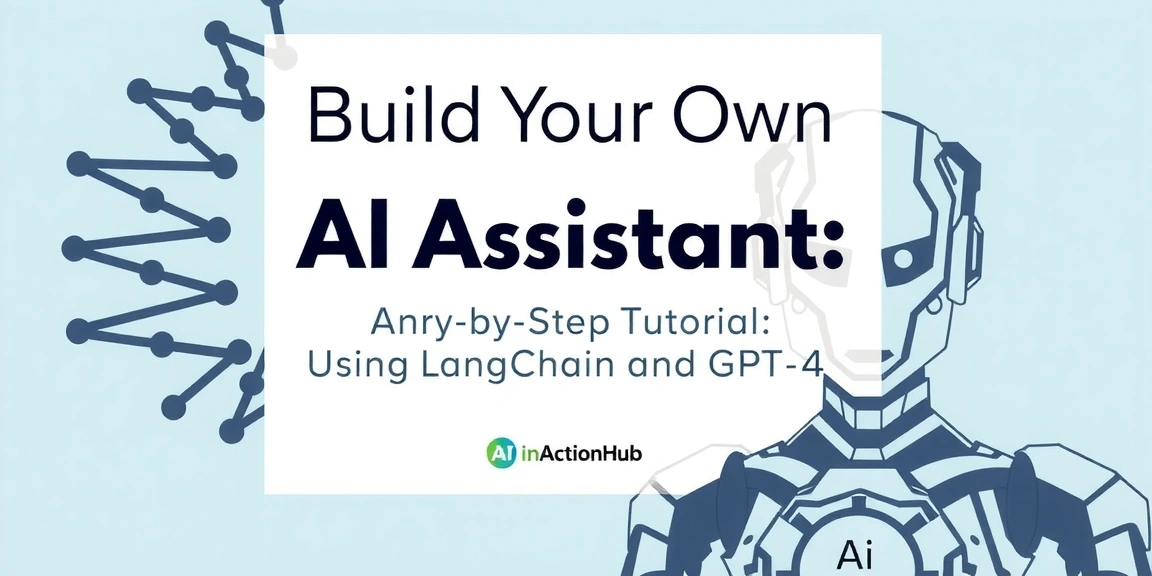
Build Your Own AI Assistant: A Step-by-Step Tutorial Using LangChain and GPT-4
1. Setting Up Your Development Environment
- Install Python 3.9+ and create a virtual environment to isolate dependencies.
- Install required libraries:
langchain,openai, andstreamlit(or Flask for a lighter interface). - Set up your OpenAI API key securely using an environment variable (e.g.,
OPENAI_API_KEY).
2. Understanding LangChain’s Core Components
- Learn the building blocks: LLMs, Chains, Prompts, and Memory – and how they interact.
- Create a simple chain that takes user input and returns a direct AI response without memory.
- Explore memory types like
ConversationBufferMemoryto keep context across turns.
3. Building the Prompt Template
- Design a system prompt that defines your AI assistant’s personality, tone, and constraints.
- Use
PromptTemplateto dynamically inject user queries into a structured prompt. - Add few-shot examples (e.g., Q&A pairs) to guide the model toward desired responses.
4. Integrating with GPT-4 via OpenAI API
- Initialize the
ChatOpenAImodel with parameters like temperature (0.7) and max tokens (500). - Create a conversation chain that wraps the model with memory to maintain dialogue history.
- Test the chain with sample queries (e.g., “What is LangChain?”) to verify coherent responses.
5. Creating a Simple Web Interface with Streamlit
- Set up a Streamlit app with a chat input box and a scrollable display area for messages.
- Connect the frontend to your LangChain backend using a callback to process each message.
- Use
st.session_stateto persist conversation history across user interactions.
6. Adding Advanced Features (Optional)
- Implement Retrieval-Augmented Generation (RAG) by integrating a VectorStore like Chroma or Pinecone.
- Enable tool use (e.g., web search, calculator) through LangChain agents for dynamic capabilities.
- Deploy your app to Streamlit Cloud, Hugging Face Spaces, or a simple VPS for public access.
7. Testing and Iterating on Your Assistant
- Run edge case tests: empty input, very long context, ambiguous questions, and off-topic queries.
- Gather user feedback and adjust the system prompt, memory settings, or model parameters.
- Monitor OpenAI API usage and optimize costs by reducing token waste (e.g., trim old messages).
“`
🤖 Editor’s Pick
Editor’s Pick: A premium notebook for tracking your AI experiments.
Get the AI Edge, Weekly
The tools, tutorials, and trends that actually pay — no hype.